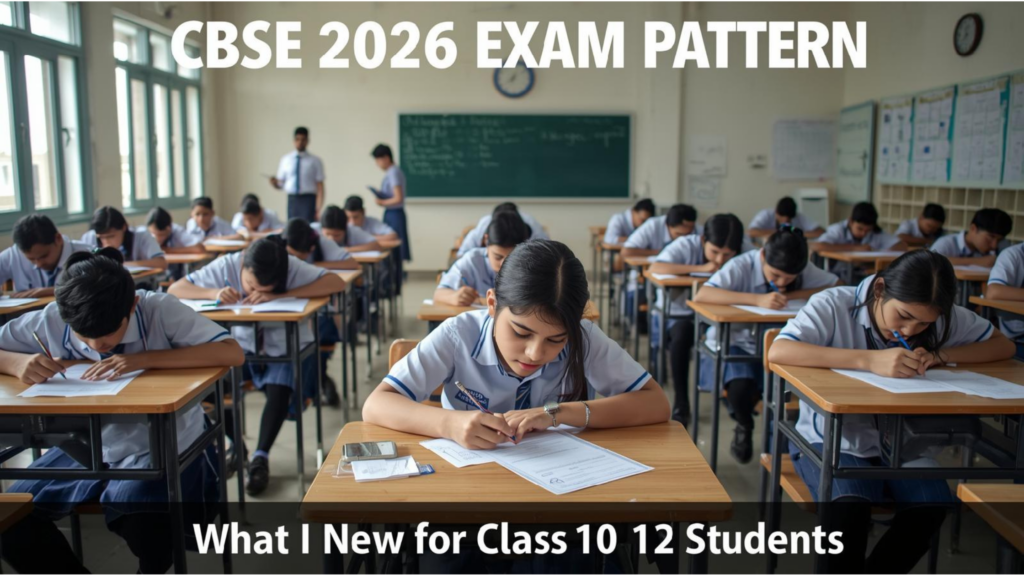
The CBSE 2026 Exam Pattern marks a significant change in India’s school education system. Both Class 10 and Class 12 students will experience a more flexible, competency-focused evaluation system. The Central Board of Secondary Education (CBSE) has introduced reforms aimed at reducing exam stress, improving conceptual understanding, and aligning assessments with real-world skills.
Rather than memorising textbooks line by line, students will now be tested on analytical thinking, practical applications, and problem-solving abilities. These reforms are part of the broader vision of the National Education Policy (NEP) 2020, which emphasizes holistic learning and competency-based education.
1. CBSE Board Exam Schedule for 2026
The CBSE 2026 Exam Pattern introduces a clear schedule for both Class 10 and 12 exams:
-
Class 10 main board exam: February–March 2026
-
Class 10 improvement exam (second chance): May 2026
-
Class 12 board exams: February–April 2026
-
Result declaration: May–June 2026
CBSE will release the detailed subject-wise timetable well ahead of the exams. This helps students plan their preparation according to the updated CBSE 2026 Exam Pattern.
2. Two-Exam System for Class 10
A major reform in the CBSE 2026 Exam Pattern is the introduction of the two-exam system for Class 10.
How It Works
-
Two board exams will be conducted in one academic year.
-
The first exam is the main board exam in February.
-
The second exam in May allows students to improve their scores.
-
Students can appear in one or both exams, with the best score considered for final results.
Benefits
-
Reduces exam stress
-
Provides a second chance to improve scores
-
Prevents delays in academic progression
-
Offers flexibility in preparation
Learn more: CBSE Academic Reforms.
This new system makes the CBSE 2026 Exam Pattern more student-friendly.
3. Attendance Rules & Eligibility Criteria
The CBSE 2026 Exam Pattern also introduces stricter eligibility rules:
-
Mandatory attendance: Students must maintain at least 75% attendance.
-
Students with less than 75% attendance may not be eligible for the exams.
-
Exceptional cases such as medical emergencies or national-level participation may allow for relaxation.
Additionally, students must be registered with a unique academic identification number, ensuring proper tracking and exam record management.
4. Major Changes in Question Paper Pattern
The CBSE 2026 Exam Pattern emphasizes competency-based questions. This shift moves away from rote learning and focuses on critical thinking and real-life application.
New Question Paper Structure (Class 10 & 12)
-
50% Competency-Based Questions
-
20% Objective-Type Questions (MCQs)
-
30% Short Answer & Long Answer Questions
This structure ensures a balanced assessment of knowledge, understanding, and analytical skills.
5. Understanding Competency-Based Questions
Competency-based questions test students’ ability to apply concepts, rather than merely recall facts. Common types include:
-
Case-study based questions
-
Assertion–reason questions
-
Data interpretation questions
-
Source-based questions
-
Real-life scenario problem-solving
These questions are a core component of the CBSE 2026 Exam Pattern, requiring reasoning and analytical thinking.
6. Class 10 Exam Pattern Highlights
Science
-
Divided into Physics, Chemistry, and Biology sections
-
Focus on experiments, reasoning, and applications
Mathematics
-
Choice between Basic and Standard Mathematics
-
Emphasis on problem-solving and reasoning
Social Science
-
Sections for History, Geography, Political Science, and Economics
-
Includes map-based and case-study questions
Languages
-
Emphasis on comprehension and writing skills
-
Grammar assessed through application-based questions
These changes reflect the CBSE 2026 Exam Pattern, designed to test understanding over memorization.
7. Class 12 Exam Pattern Key Points
For Class 12 students, the CBSE 2026 Exam Pattern maintains the competency-based structure but with deeper subject coverage.
-
Application-oriented questions in Science, Commerce, and Humanities
-
Emphasis on practicals and project work
-
Case-study and problem-solving questions in subjects like Business Studies, Economics, Physics, Chemistry, and Mathematics
-
Internal assessment remains important for overall evaluation
8. Internal Assessment & Practical Weightage
Internal assessment now plays a critical role in the CBSE 2026 Exam Pattern:
-
Components: Periodic tests, projects, practical exams, assignments, class participation
-
Weightage: 20–30% of total marks
-
Consistent performance throughout the year is required, not just last-minute exam prep
9. New 9-Point Grading System
The CBSE 2026 Exam Pattern introduces a 9-point grading system:
-
More precise evaluation of performance
-
Differentiates closely ranked students
-
Reduces clustering of grades
-
Helps colleges and universities interpret results clearly
Grades are based on relative performance rather than absolute marks alone.
10. Passing Criteria
-
Students must secure at least 33% in each subject
-
Both theory and internal components must be cleared
-
Failure in any subject may require a compartment or improvement exam
These rules remain consistent with the CBSE 2026 Exam Pattern focus on fairness and clarity.
11. Student Support & Mental Health
CBSE emphasizes student well-being during exams:
-
Free psychological counseling services
-
Tele-counseling helplines
-
Stress management and exam planning resources
These initiatives are integrated into the CBSE 2026 Exam Pattern to help students perform at their best without undue stress.
12. New Marksheet & Admission Flexibility
-
Provisional marksheets after the first exam allow Class 11 admission
-
Final marksheets issued after completion of the second exam cycle
-
Ensures students’ academic progression is not delayed
This is a new feature of the CBSE 2026 Exam Pattern that supports flexibility.
13. Examination Fees Update
-
Slight increase in registration and subject fees
-
Separate fees for improvement exams
-
Schools manage fee collection
Students and parents should confirm fees during registration.
14. Preparation Tips for CBSE 2026 Exams
Study Strategy
-
Focus on conceptual understanding rather than memorization
-
Practice case-based and competency questions
Use Sample Papers
-
Solve updated question banks
-
Analyse marking schemes carefully
Consistency
-
Perform well in internal assessments
-
Follow a regular study schedule
Mental Health
-
Avoid last-minute cramming
-
Take breaks and maintain a balanced routine
Adhering to these strategies will help students excel in the CBSE 2026 Exam Pattern.
To s쳮d with the CBSE 2026 Exam Pattern, students should build strong foundational knowledge and also consider future educational pathways beyond school. For example, understanding modern interdisciplinary fields such as sustainability and leadership can broaden career outlooks after schooling. You can explore programs like ESG MBA Programs in the USA for Climate & Sustainable Leadership to learn how emerging global trends are shaping higher education and career choices.